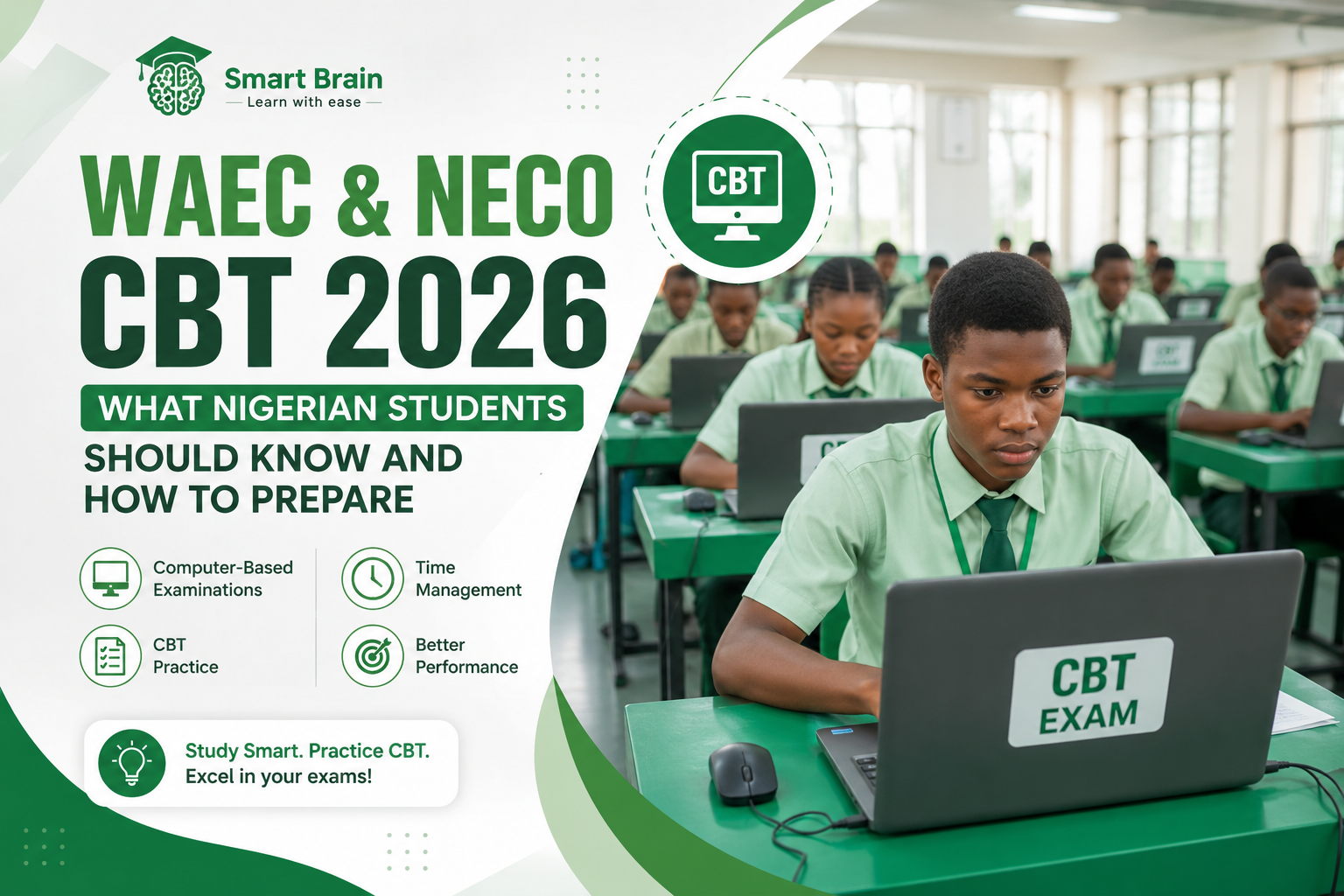
WAEC & NECO CBT 2026: What Nigerian Students Should Know and How to Prepare
Computer-based testing is becoming an increasingly important part of examinations in Nigeria. For secondary school students preparing for WAEC and NECO, exam preparation is no longer only about knowing the syllabus and answering questions correctly; students also need to become comfortable with answering questions on a computer. The best approach is simple: prepare academically and practise the CBT environment at the same time.
What Does CBT Mean?
CBT means Computer-Based Test. Instead of answering questions entirely on paper, candidates use a computer to read questions, select answers, navigate between questions and submit responses. Students who are already familiar with JAMB CBT may have an advantage, but WAEC and NECO preparation still requires mastery of each examination's syllabus and requirements.
Why Should WAEC and NECO Students Start Practising CBT?
Imagine knowing the correct answer to a Mathematics question but wasting several minutes because you are struggling to navigate the computer interface. CBT practice helps students become familiar with reading questions on a screen, selecting answers, moving between questions, reviewing answers, managing time, using a mouse, working under timed conditions and remaining calm during a test. The goal is to make the computer feel normal during an examination.
1. Master Your WAEC and NECO Syllabus First
CBT does not replace knowledge. Start by identifying all the topics you need to cover for each registered subject. A Mathematics student might systematically revise number bases, fractions, algebra, equations, geometry, trigonometry, statistics, probability, graphs and mensuration. Check the relevant examination body's current syllabus and requirements rather than relying on an unofficial list.
- Number bases and fractions
- Algebra and equations
- Geometry and trigonometry
- Statistics and probability
- Graphs and mensuration
2. Start CBT Practice Before the Examination
Do not wait until examination week before using a computer to answer questions. Make CBT practice part of your normal study routine.
- Monday: Mathematics lesson
- Tuesday: Mathematics CBT practice
- Wednesday: English revision
- Thursday: English CBT practice
- Friday: Science revision
- Saturday: Timed CBT test
- Sunday: Review mistakes
3. Learn How to Manage Your Time
Time management becomes especially important when answering questions digitally. Do not spend too long fighting with one difficult question. If the examination system allows movement between questions, answer the questions you know first and return to difficult ones later according to the platform's instructions. A useful strategy is Easy → Moderate → Difficult.
4. Practise Reading From a Screen
Some students are comfortable reading textbooks but become slower when reading from a computer screen. Improve this by regularly reading digital textbooks, online lessons, practice questions, articles and examination passages.
5. Do Not Depend Only on Past Questions
Past questions are useful, but they should not replace proper learning. Use them to identify frequently tested concepts, weak areas, question patterns, revision needs, speed and accuracy. After every question, ask why the answer is correct; if you were wrong, ask why you chose the wrong answer.
6. Keep a Mistake Journal
Whenever you make a mistake, record the question, the reason you got it wrong, the correct method and the lesson to remember next time. After several weeks, your mistake journal becomes a personal revision guide.
7. Practise Under Examination Conditions
At least once or twice every week, simulate an examination. Set a timer, sit properly, remove distractions, use CBT questions and do not check answers until the test is finished. Then calculate your score and review your mistakes. This helps you develop exam stamina.
8. What About Students Who Are Not Good With Computers?
Do not panic. You do not need to become a computer expert before taking a CBT examination. Start with the basics: move the mouse, click an option, scroll, read instructions, select an answer, move to the next question, return to a previous question where permitted and use the keyboard when required. Spend 15–20 minutes practising these skills regularly.
9. Do Not Ignore WAEC and NECO Theory Preparation
Do not assume that because CBT is becoming more common, every aspect of an examination can be prepared for like a multiple-choice test. The exact format can vary by examination, subject, candidate category and implementation phase. Follow the latest official instructions and timetable for your examination, not social-media rumours.
10. A Simple 30-Day CBT Preparation Plan
A focused month can build confidence when combined with syllabus study.
Week 1 — Computer Confidence
Practise mouse control, selecting answers, scrolling, moving between questions and reading questions on screen. Complete short CBT tests.
Week 2 — Subject Practice
Choose your major subjects, complete CBT questions after studying each topic and record mistakes.
Week 3 — Timed Practice
Take longer timed tests and work on speed, accuracy, concentration and time management.
Week 4 — Examination Simulation
Take full-length practice tests as if they were the real examination. Analyse mistakes and revise your weakest topics.
Common Mistakes Students Should Avoid
Avoid waiting until examination week to practise CBT, memorising answers without understanding the topic, spending too long on one question, ignoring difficult subjects, practising without reviewing mistakes, believing every online rumour and not practising CBT at all.
How Smart Brain Can Help
Preparing for WAEC, NECO and JAMB requires more than answering random questions. Students need to learn, practise, test themselves and identify weaknesses. Smart Brain supports Nigerian secondary school and UTME students with structured learning resources, video lessons, quizzes and CBT practice. Start preparing before the pressure begins. Download Smart Brain and make learning part of your daily routine using the existing Google Play CTA.
Final Advice for Nigerian Students
The transition toward computer-based examinations should not frighten students. Study the syllabus, understand your subjects, practise questions, practise CBT, manage your time, learn from mistakes and start early. The student who begins today has more time to improve examination confidence.
A final reminder
Don't just prepare to answer questions. Prepare to perform confidently under examination conditions.
Important Notice
Examination formats, registration requirements, timetables and other examination information can change. Confirm current information directly from the relevant examination bodies before making important examination decisions. Do not present rumours or unconfirmed social-media claims as official information.
Frequently asked questions
Is WAEC becoming computer-based?
WAEC is transitioning toward computer-based testing, but students should check the latest official WAEC information for the examination and subjects they are taking.
Is NECO CBT in 2026?
NECO has introduced computer-based examination arrangements, including hybrid CBT and pen-and-paper arrangements for certain examinations. Check NECO's latest official announcements for your specific examination.
Do I need to be a computer expert before taking a CBT examination?
No. Students mainly need basic skills such as using a mouse, selecting answers, scrolling, reading instructions and navigating questions.
How can I prepare for WAEC and NECO CBT?
Study your syllabus, practise examination questions, use CBT practice regularly, take timed tests and review your mistakes.
Can JAMB CBT practice help WAEC and NECO students?
Yes. It can make students more comfortable reading questions and selecting answers on a computer, but they must still prepare for the specific WAEC or NECO syllabus and requirements.
Ready to learn and practise?
Download Smart Brain on Google Play and start learning.