
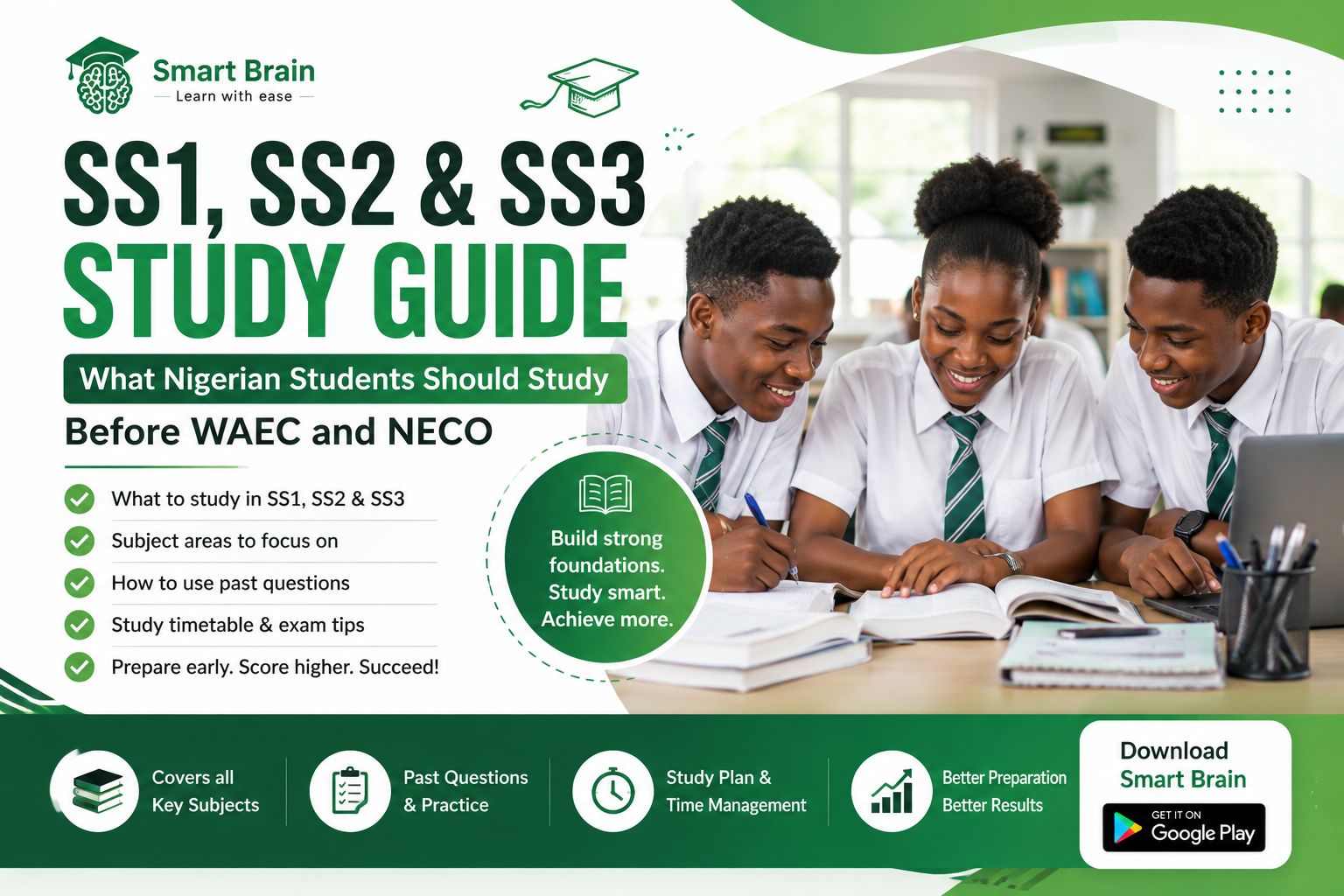
SS1, SS2 & SS3 Study Guide: What Nigerian Students Should Study Before WAEC and NECO
WAEC and NECO preparation should not begin only a few weeks before the examination. Nigerian secondary school students build stronger results when they develop knowledge and study habits from SS1 through SS3. This guide helps students, parents and teachers understand what to focus on at each stage, how to use past questions, how to organise revision and how to prepare without relying on last-minute study.
What Should an SS1 Student Focus On?
SS1 is the foundation of Senior Secondary School. The goal is not to rush into final-examination pressure, but to understand core ideas and develop habits that will make later WAEC preparation and NECO preparation easier.
- Build confidence with Mathematics and basic algebra.
- Read English passages carefully and practise comprehension, vocabulary and writing.
- Learn introductory Physics, Chemistry and Biology where these subjects are part of your programme.
- Understand the foundations of Economics, Government, Geography and other relevant subjects.
- Develop a regular study and examination routine rather than waiting for tests.
A Practical SS1 Study Routine
An SS1 student can begin with 30–60 minutes of focused revision on school days. Review what was taught that day, solve a few questions without looking at the answer, write down unfamiliar words or concepts and ask for help with anything unclear. One longer session at the weekend can be used to revise the week's work and prepare for the next week.
What Should an SS2 Student Focus On?
SS2 is an important stage before SS3. Students should complete topics properly instead of carrying gaps forward. This is a good time to revise SS1 knowledge, practise examination-style questions, improve speed and accuracy and identify subjects that need more attention.
- Review foundation topics regularly.
- Begin consistent WAEC study guide and NECO study guide practice with topics already covered.
- Use past questions to become familiar with question styles, not to memorise answers.
- Track weak subjects and ask a teacher, parent or tutor for support.
- Practise explaining concepts in your own words.
What Should an SS3 Student Focus On?
SS3 should involve structured examination preparation. Start with the current syllabus and make a list of topics for each subject. Mark difficult concepts, revise them deliberately, practise WAEC and NECO-style questions, work under timed conditions and review every mistake. A revision timetable should include school work, rest and realistic daily targets.
- Revise the syllabus topic by topic.
- Prioritise difficult concepts instead of avoiding them.
- Complete timed practice and full revision sessions.
- Keep a correction record and revisit it every week.
- Ask for clarification early when a topic is not understood.
Important Subject Areas
The subjects below are common areas of preparation, but not every Nigerian student offers all of them. Your subjects depend on your school programme, examination requirements and intended course or career path. Confirm the subjects relevant to your own programme before building a timetable.
Mathematics
Develop number skills, algebra, equations, graphs, geometry, mensuration, trigonometry, statistics and probability where they are part of your syllabus. Focus on understanding why a method works, then practise enough examples to use it accurately under time pressure. See the existing Mathematics formulas and concepts article for focused revision support.
English Language
Build comprehension, vocabulary, grammar, summary and writing skills. Read passages carefully, answer from the evidence in the passage and practise expressing ideas clearly. Regular reading also helps you recognise how questions are phrased.
Physics
Understand measurements, motion, forces, energy, heat, waves, electricity and other topics included in your current syllabus. Draw diagrams, define quantities and check units before choosing an equation. Connect formulas to physical situations rather than memorising them without context.
Chemistry
Learn particles and matter, atomic structure, the periodic table, bonding, chemical equations, acids and bases, organic chemistry and practical ideas where applicable. Practise balancing equations and explaining observations in clear steps.
Biology
Study cells, nutrition, classification, ecology, genetics, reproduction, health and other topics in your syllabus. Use labelled diagrams and compare related processes. Biology revision is stronger when you understand relationships instead of memorising isolated sentences.
When Should You Start WAEC and NECO Preparation?
A useful progression is simple:
- SS1: Build the foundation and develop steady study habits.
- SS2: Strengthen knowledge, close gaps and begin serious examination practice.
- SS3: Revise, practise past questions and prepare under timed conditions.
Start earlier, study more calmly
Early preparation does not mean studying all day. Even 30–60 minutes of focused revision, repeated consistently, can become valuable over an academic year. It is better to build understanding gradually than to depend on stressful all-night revision in examination week.
How to Use WAEC and NECO Past Questions Properly
Past questions should support learning rather than replace it. Use this cycle: Learn → Practise → Mark → Identify mistakes → Study again → Practise again. First learn the topic, then attempt questions without copying a solution. Mark honestly, identify the exact weak topic and return to the lesson before trying a similar question.
- Group mistakes by topic so recurring gaps become visible.
- Record whether the problem was knowledge, calculation, interpretation or time management.
- Repeat missed questions later without looking at the answer.
- Use timed practice only after you understand the underlying method.
Create a Weekly Study Timetable
Use the example below as a starting point and adjust it to your school schedule, subjects and energy levels.
Example weekly routine
Monday — Mathematics revision and practice questions. Tuesday — English comprehension, vocabulary and writing. Wednesday — Major science or commercial subject. Thursday — Second major subject and correction of mistakes. Friday — Short review of the week's lessons. Saturday — Past questions, timed practice and weak-topic revision. Sunday — Light review, planning and rest.
Keep a Mistake Journal
A mistake journal is a small notebook or digital record of questions you got wrong or concepts you did not understand. For each entry, record:
- 1. The question.
- 2. Your answer.
- 3. The correct answer.
- 4. Why you were wrong.
- 5. What you need to remember.
Review it regularly
Set aside time each week to revisit the journal. Correcting the same type of mistake repeatedly is a useful signal that the topic needs a different explanation, more examples or help from a teacher.
Do Not Wait Until Examination Week
Last-minute preparation is risky because there is not enough time to understand difficult concepts, practise questions, review mistakes and build confidence. Consistent study throughout the academic year gives you more opportunities to ask questions, adjust your timetable and improve gradually.
How Smart Brain Can Help
Smart Brain is designed for Nigerian Senior Secondary School students and supports learning through video lessons, notes and learning materials, quizzes, CBT practice, AI-assisted learning and progress tracking. Use it to break a large syllabus into manageable tasks and to combine learning with practice. It is a study resource, not a promise of a particular WAEC or NECO result.
Continue your preparation
For related reading, explore the JAMB 2027 preparation guide, WAEC & NECO CBT preparation tips, Mathematics formulas and concepts, the Physics revision guide, the Chemistry equations guide and other Study Tips articles already available on the Smart Brain blog. Ready to study smarter? Use Smart Brain to learn with video lessons, quizzes, CBT practice and AI-assisted learning designed to support Nigerian students, then download Smart Brain using the existing Google Play CTA.
Final Advice
SS1 students should build their foundation. SS2 students should strengthen their knowledge and begin serious examination practice. SS3 students should organise revision and practise strategically. Consistent study, understanding concepts, practising questions and asking for help are more useful than trying to learn everything at the last minute.
Frequently Asked Questions
These answers are general study guidance. Students should follow the requirements and syllabus that apply to their own school programme and examination.
When should an SS1 student start preparing for WAEC?
An SS1 student can start by building foundational knowledge and steady study habits. Formal examination pressure does not need to begin immediately, but daily review makes later preparation easier.
Can SS2 students start using WAEC past questions?
Yes. Use past questions for topics already studied, mark honestly and return to the lesson when you find a gap. Do not rely on memorising answers.
How should an SS3 student prepare for WAEC and NECO?
Use the syllabus to plan revision, prioritise weak topics, practise past questions, take timed tests, review mistakes and maintain a realistic timetable that includes rest.
How many hours should a secondary school student study each day?
There is no single number for everyone. Start with a focused session that fits your school workload and concentration, such as 30–60 minutes, then adjust based on your subjects and progress.
Are WAEC and NECO preparation the same?
They share many learning skills, but students should follow the syllabus, format and requirements for each examination. Prepare for the specific subjects and papers you will take.
How can I improve my Mathematics before WAEC?
Review foundations, learn the method behind each topic, practise regularly, work through past questions and keep a record of calculation and interpretation mistakes.
How can I remember what I study?
Use active recall, explain ideas in your own words, practise questions, revisit material over several days and connect new ideas to examples or diagrams.
Is practising past questions enough to pass WAEC?
No. Past questions are useful practice, but they should be combined with learning the syllabus, understanding concepts, correcting mistakes and practising under appropriate conditions.
What should I do if I do not understand a topic?
Break it into smaller ideas, try another explanation, use a worked example, ask a teacher or trusted tutor and practise a simpler question before returning to the harder one.
Frequently asked questions
When should an SS1 student start preparing for WAEC?
Start with foundational learning and consistent study habits in SS1; this makes formal examination preparation in SS2 and SS3 more manageable.
Can SS2 students use WAEC past questions?
Yes. Use questions for topics already studied, mark honestly and review the concepts behind mistakes.
How should an SS3 student prepare for WAEC and NECO?
Follow the syllabus, revise weak topics, practise past questions, take timed tests and review mistakes with a realistic timetable.
Is practising past questions enough to pass WAEC?
No. Combine past questions with learning the syllabus, understanding concepts, correcting mistakes and asking for help.
Ready to learn and practise?
Download Smart Brain on Google Play and start learning.